新闻中心
NEWS CENTER
HUAON
PART ONE
Overview of the Game-Export Industry
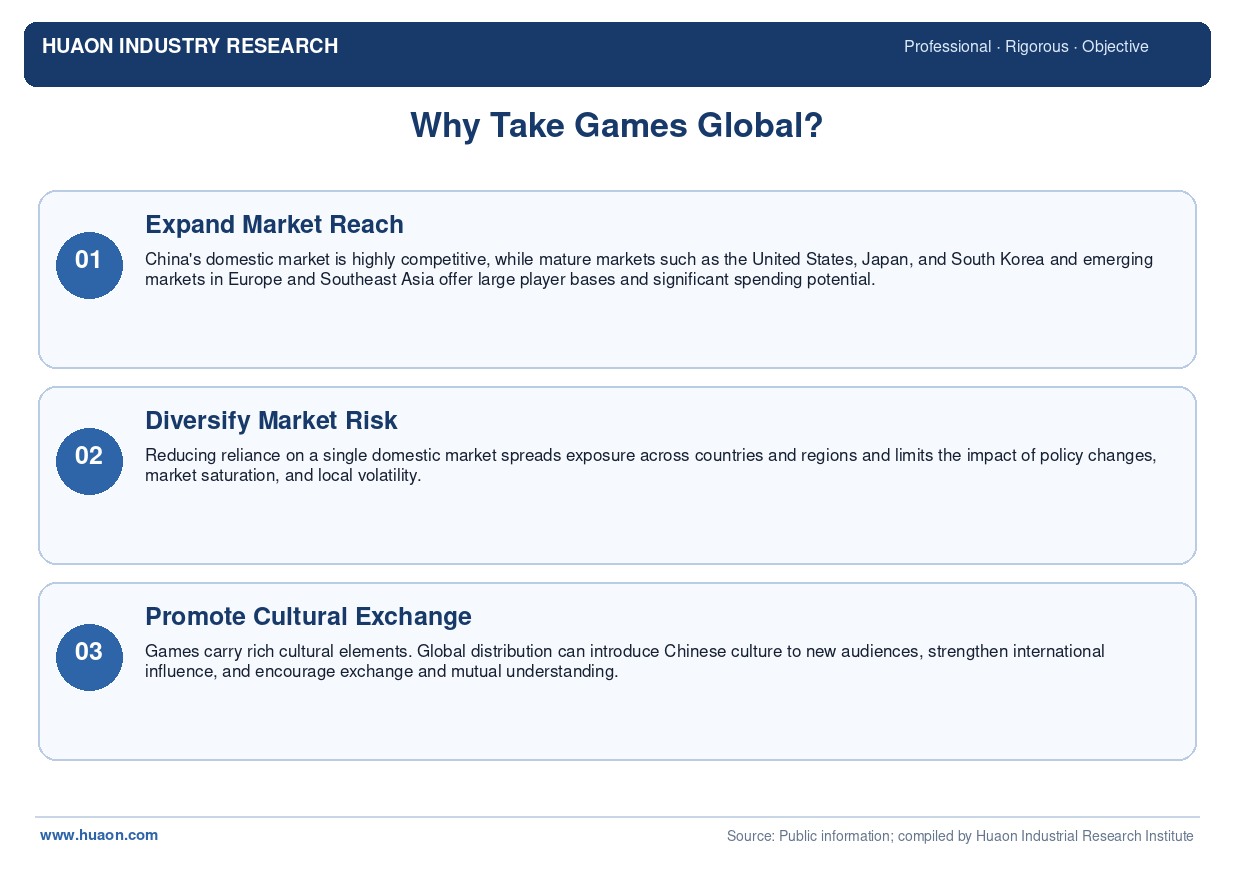
Game export refers to the commercial practice whereby game companies bring games they have developed or licensed to overseas markets through various channels and methods. The objectives are to expand the scope of their business, reach more users, strengthen brand influence, and generate commercial returns. The process spans localization, publishing, operations, marketing, and other stages. Companies must carefully consider the culture, laws, and market demand of each country and region, then make targeted adjustments and improvements so their games align with local player preferences and market conditions.
HUAON
PART TWO
Background to the Development of the Game-Export Industry
1. Policy Environment
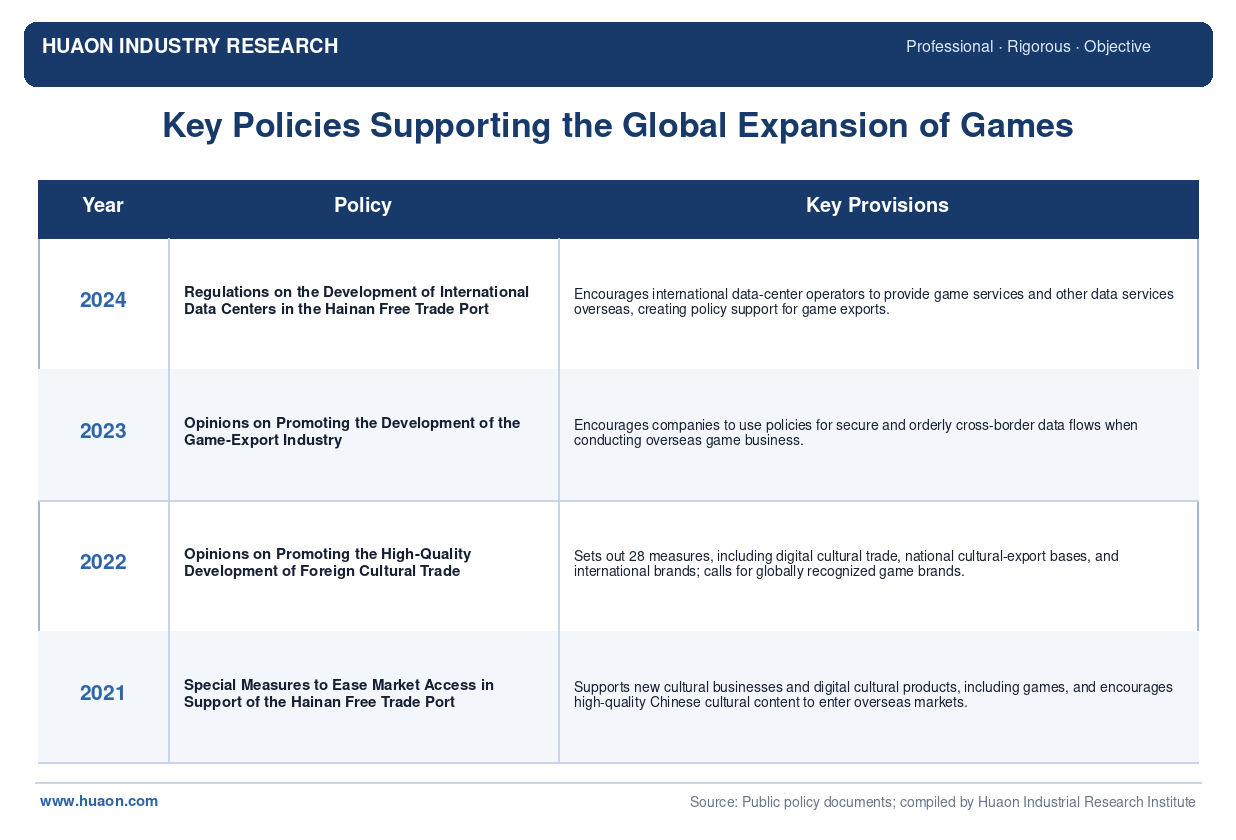
In recent years, policy support has given game companies greater confidence to expand overseas, helping them increase their share of the global market and grow revenue. The emphasis on digital cultural trade is bringing China's game industry closer to international markets, introducing advanced technologies and ideas, and promoting innovation at home. Policies encouraging cultural products to go global also help Chinese cultural elements embedded in games reach overseas audiences, enhancing China's cultural influence and soft power. Support for key companies and projects can foster internationally competitive game companies and well-known brands that set benchmarks in global markets and drive the healthy development of the industry.
2. Social and Market Environment
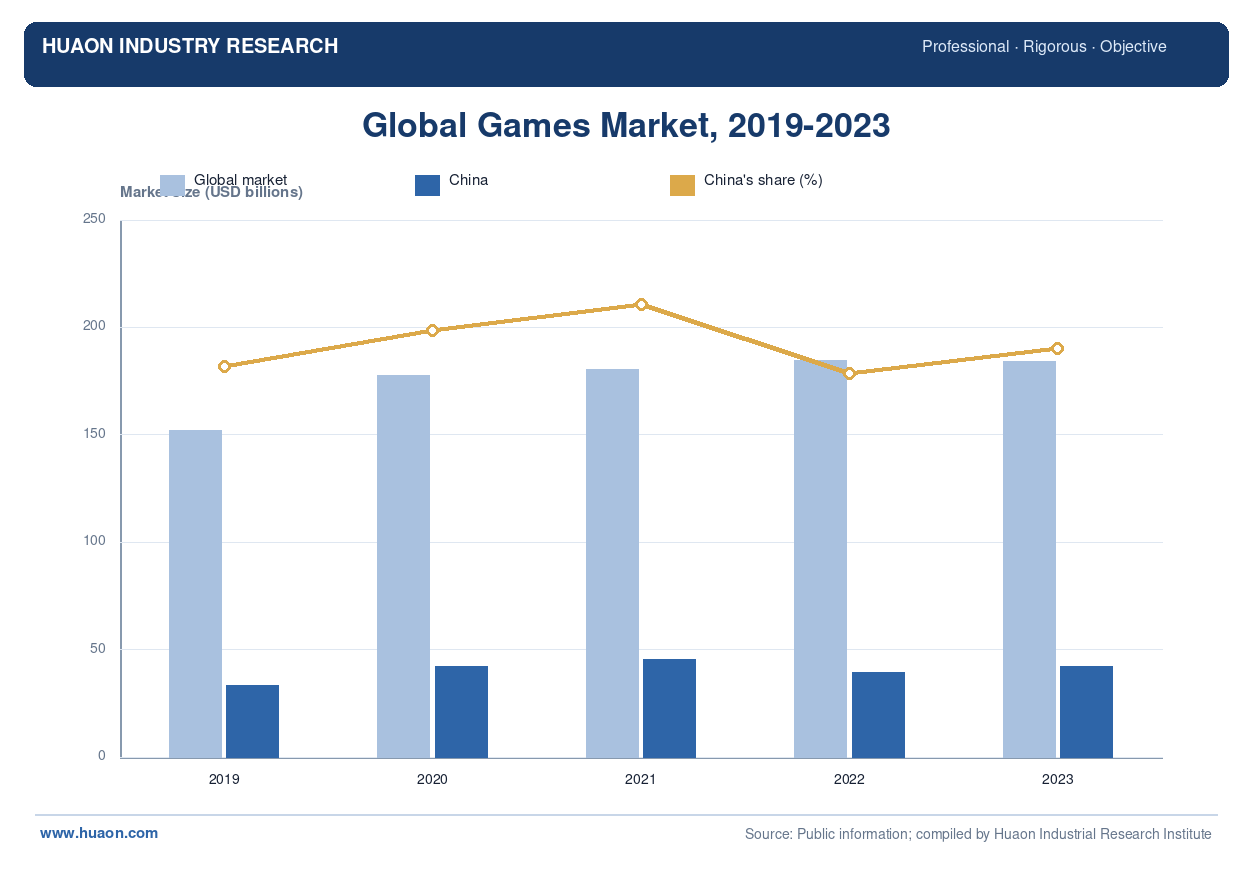
The global games market was worth USD 183.9 billion in 2023. China, the rest of Asia-Pacific, North America, and Europe contributed USD 42.0 billion, USD 42.6 billion, USD 49.9 billion, and USD 33.7 billion, respectively. The Asia-Pacific market is led by China, Japan, and South Korea; North America is led by the United States and Canada; and Europe's principal markets include Germany, France, the United Kingdom, Spain, and Portugal. On this basis, China accounts for approximately 23% of the global market and is the world's largest single-country games market. Overseas markets are about 3.37 times the size of China's domestic market, leaving considerable room for further expansion.
HUAON
PART THREE
Game-Export Industry Value Chain
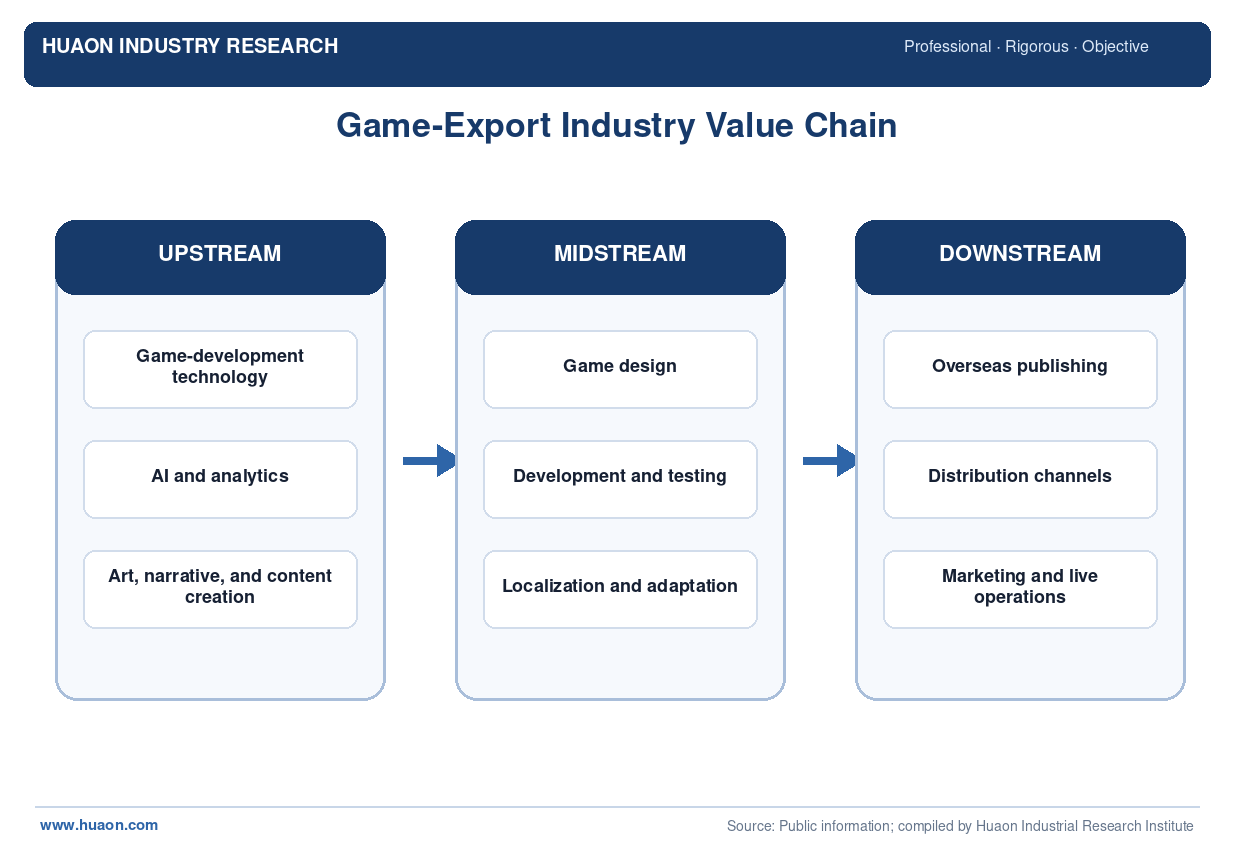
The upstream, midstream, and downstream segments of the game-export value chain have clearly defined roles and work together to bring games to international markets. Upstream activities provide technology and content support: AI can optimize game design and improve the player experience, while high-quality art, narrative design, and other creative work provide the foundation for a game. The midstream segment covers game development, with studios building competitive products around market demand and their own strengths. Downstream activities include publishing and marketing. Publishers bring games to overseas markets, work with local channels, and run marketing campaigns to build awareness and influence, attract overseas players, and generate revenue.
HUAON
PART FOUR
Current Development of the Game-Export Industry
1. Overseas Revenue from China's Domestically Developed Games
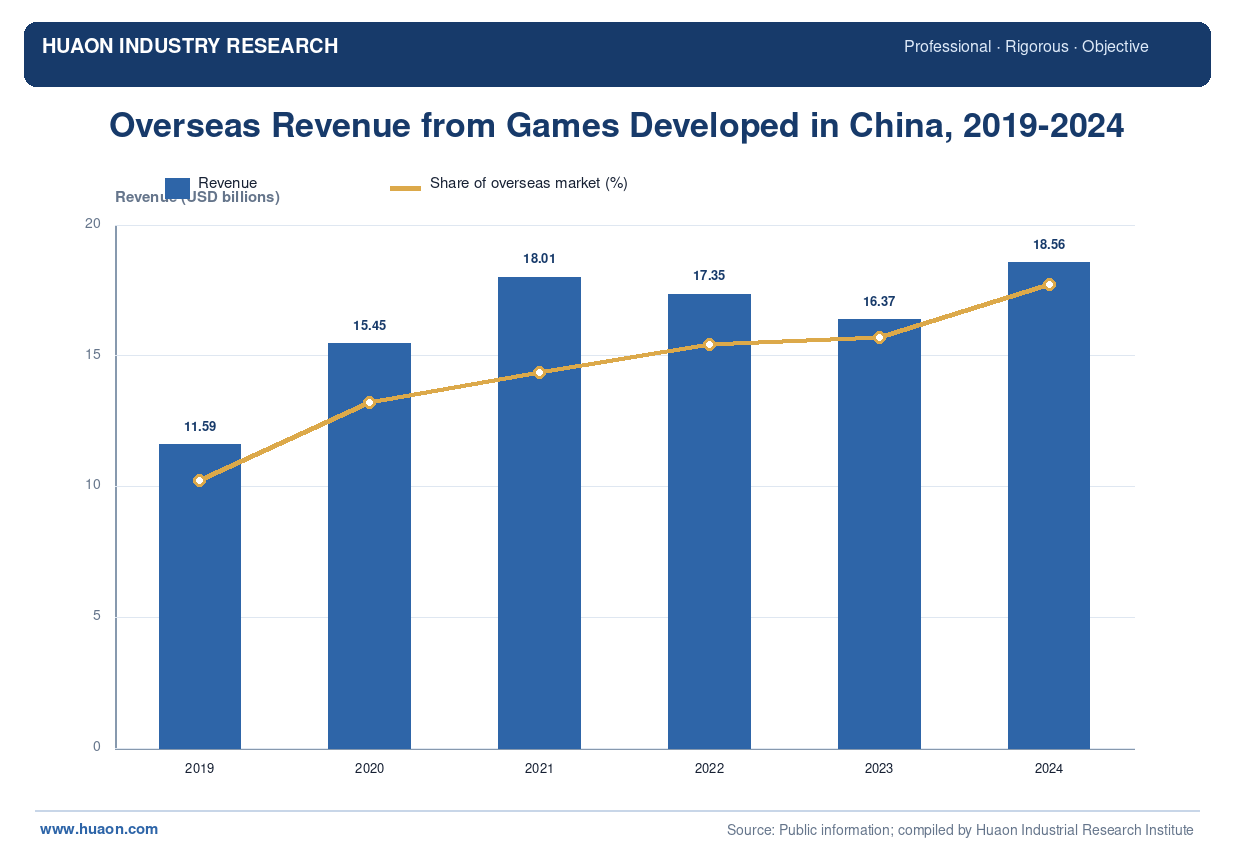
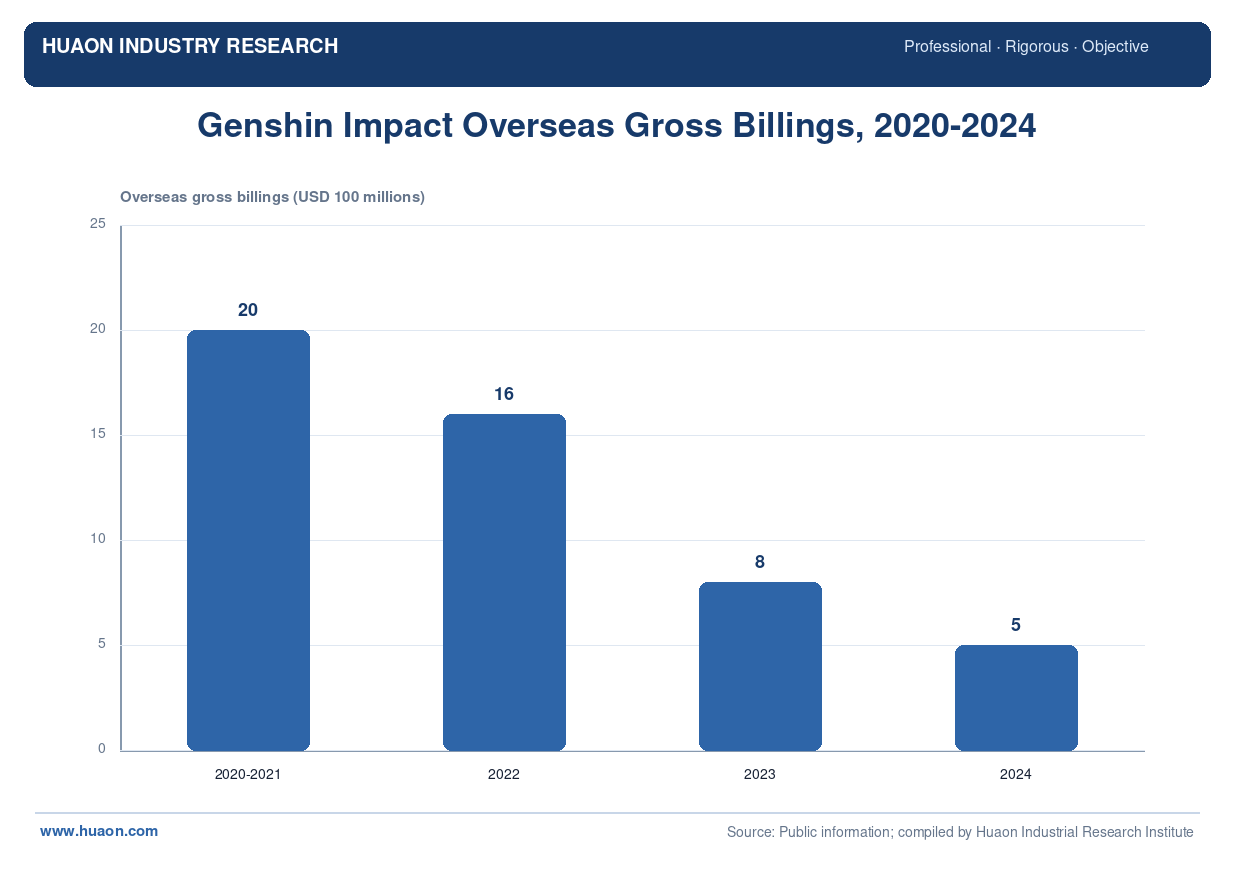
According to the Game Publishing Committee of the China Audio-Video and Digital Publishing Association, overseas revenue from games developed in China rose from approximately USD 3.1 billion in 2014 to USD 18.557 billion in 2024 after a decade of rapid growth. Revenue peaked at USD 18.0 billion in 2020-2021, driven by blockbuster titles such as Genshin Impact and the stay-at-home economy. It then declined in 2022 and 2023 amid macroeconomic pressures and insufficient innovation in new releases. In 2024, continued innovation and market expansion by Chinese game companies reversed two consecutive years of decline. Actual overseas sales revenue reached USD 18.557 billion, up 13.39% year on year.
2. Geographic Distribution of Revenue from Chinese Games Overseas
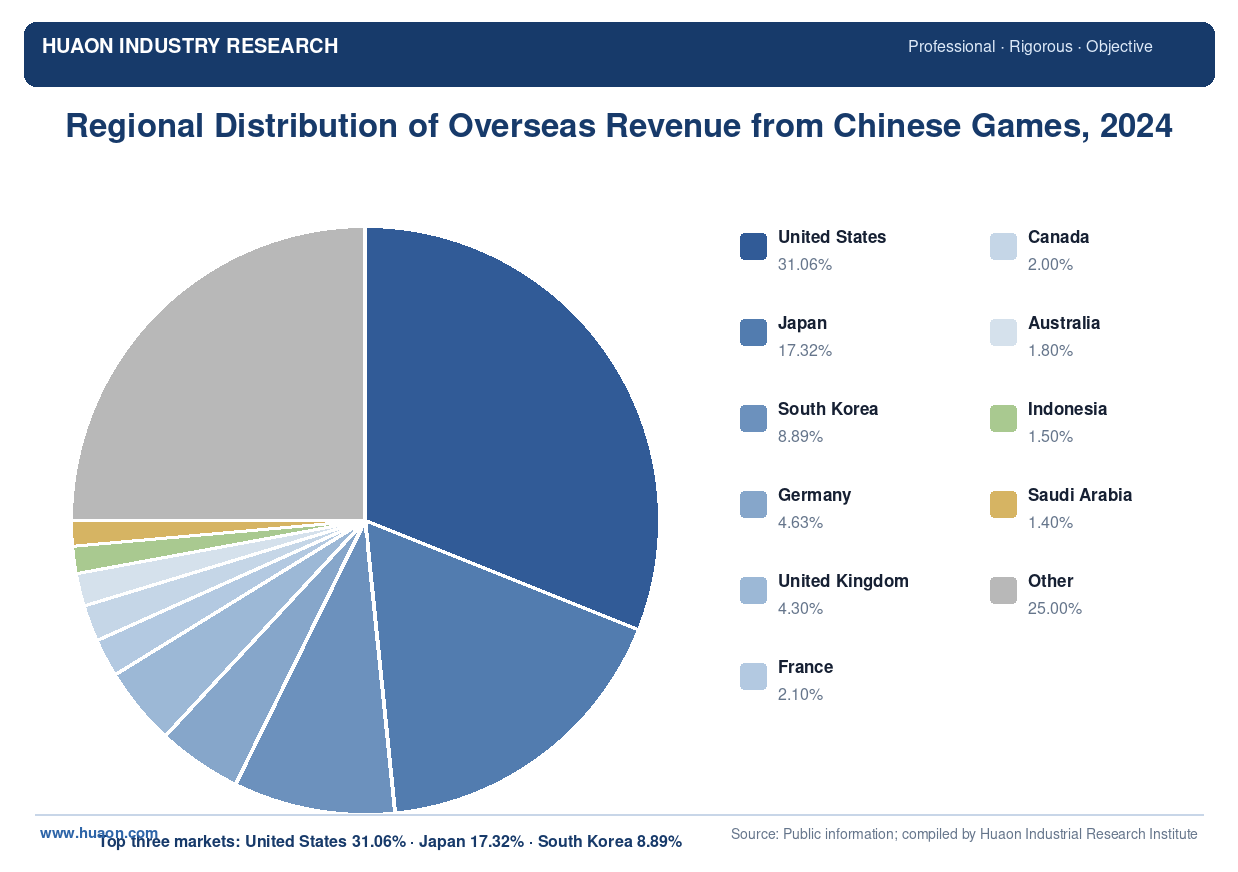
In 2024, the five largest markets for overseas revenue from Chinese games were the United States, Japan, South Korea, Germany, and the United Kingdom. The United States, Japan, and South Korea ranked first, second, and third, accounting for 31.06%, 17.32%, and 8.89%, respectively. China also continued to make progress in other markets; Saudi Arabia, for example, entered the top ten overseas markets by revenue for Chinese games.
3. Monthly Overseas Revenue from China's Domestically Developed Games
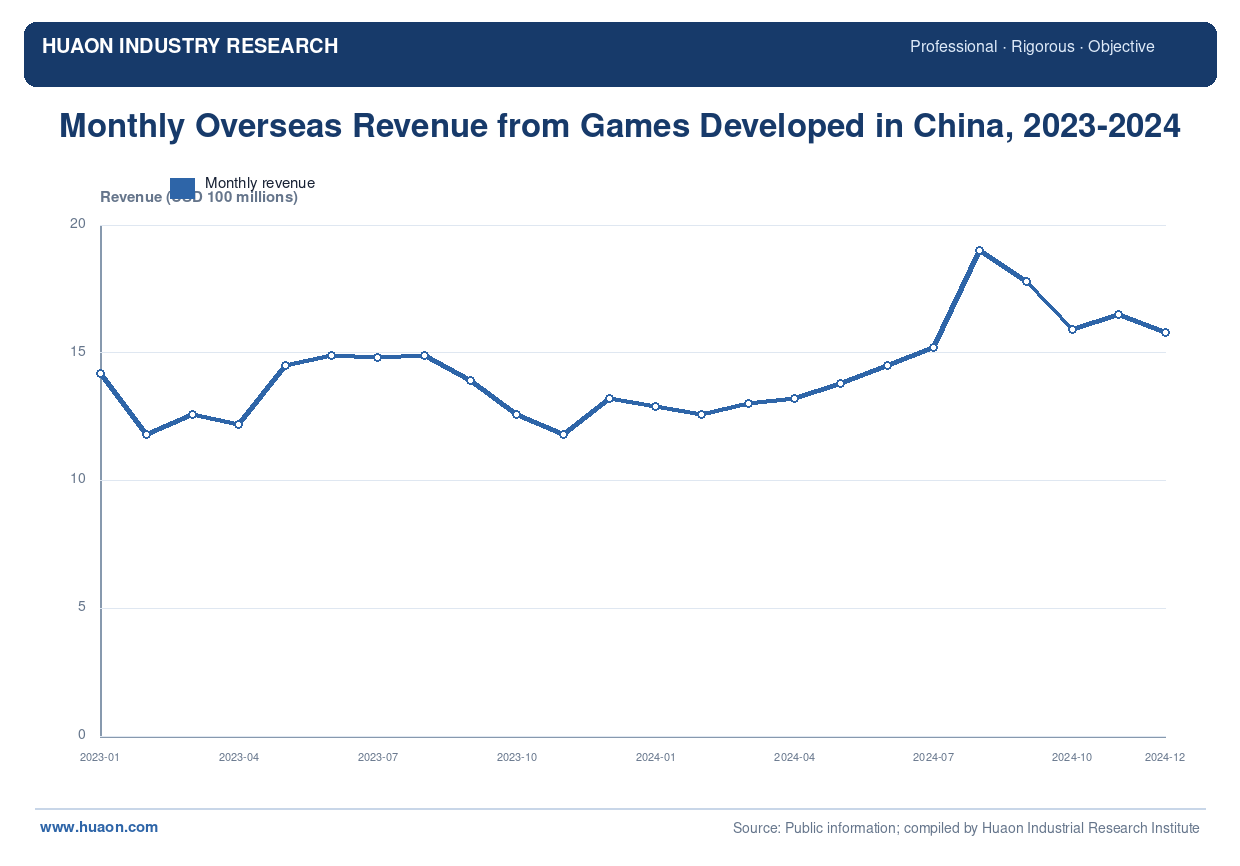
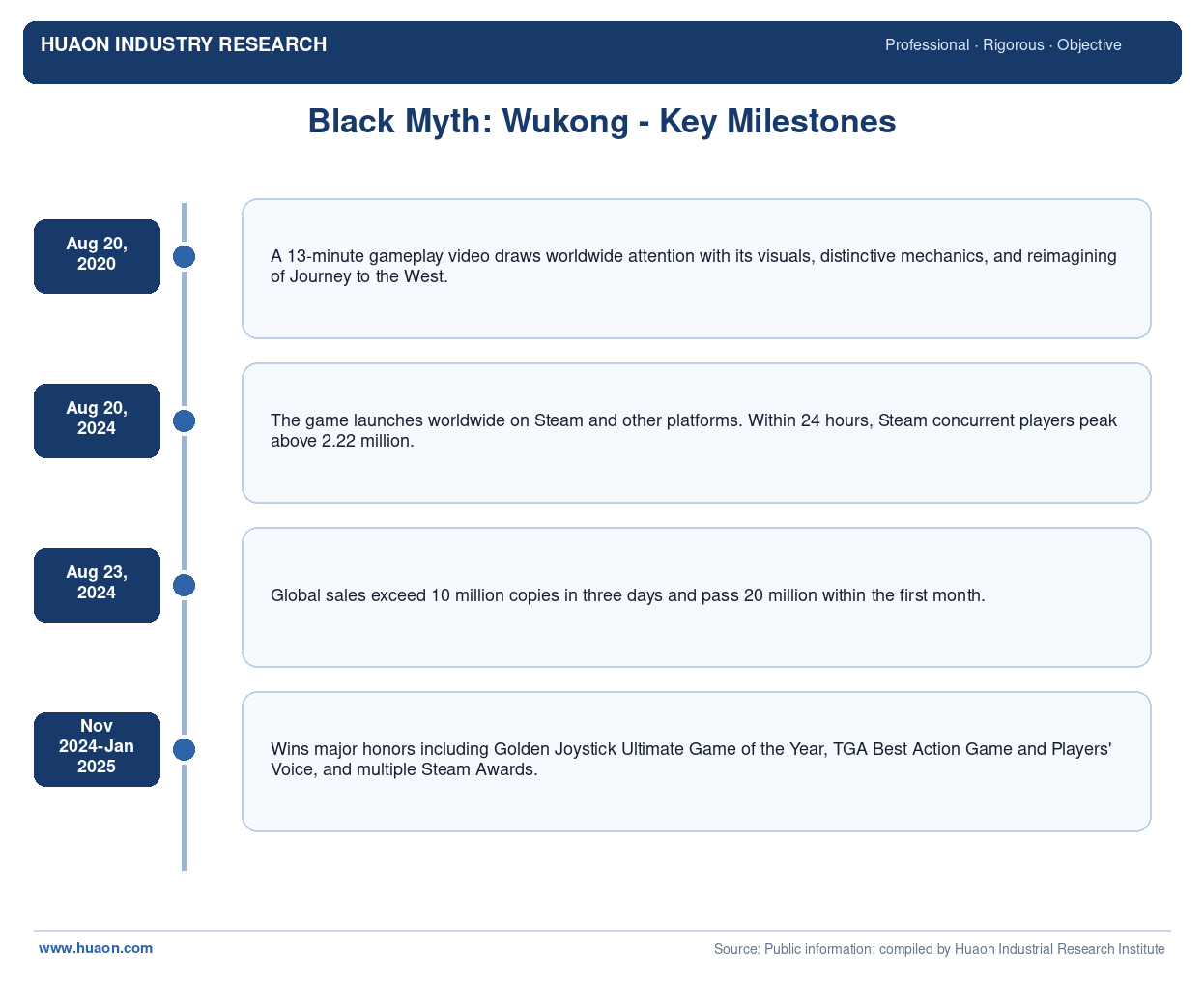
Over the past two years, monthly overseas revenue from games developed in China generally remained around USD 1.5 billion. A modest surge arrived in the third quarter of 2024, driven largely by incremental revenue from miHoYo's mobile title Zenless Zone Zero, which entered open beta on July 4 and was the fastest-growing Chinese game overseas by gross billings that quarter. China's first domestically developed AAA single-player game, Black Myth: Wukong, launched on August 20. Its outstanding visual and artistic presentation, imaginative story and character design, and distinctive combat and skill systems earned acclaim in China and abroad, helping overseas revenue rise quickly in August and September.
4. Revenue Mix of China's Domestically Developed Mobile Games Overseas
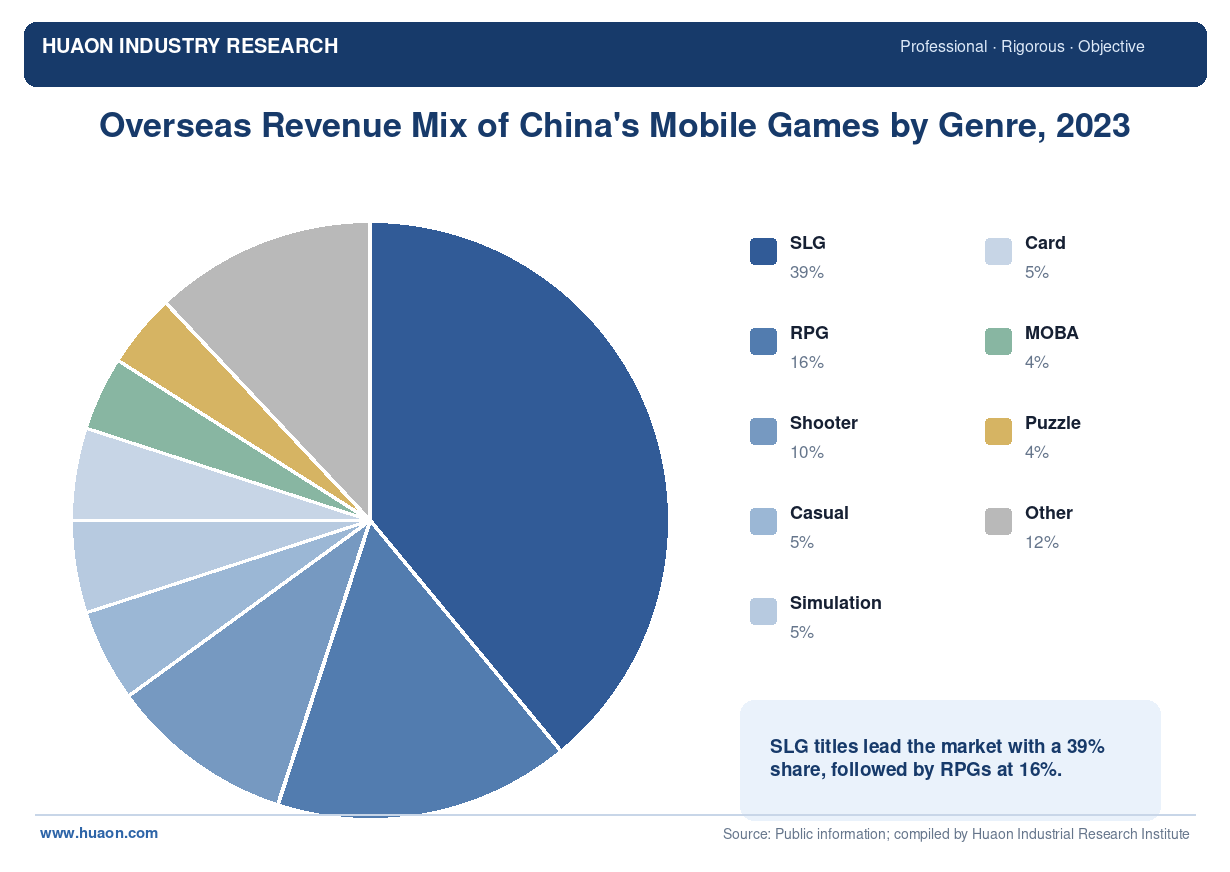
By genre, strategy games, particularly SLG titles, lead the overseas market for China's domestically developed mobile games. In 2024, SLG titles accounted for 39% of overseas revenue, the largest share, followed by RPGs at 16%. Shooters, casual games, simulation games, card games, MOBAs, match/puzzle games, and other genres accounted for 10%, 5%, 5%, 5%, 4%, 4%, and 12%, respectively. Of particular note, the overseas revenue share of casual games has risen rapidly in recent years.
Related report: Market Competition and Development Trends in China's Game-Export Industry, 2025-2031, published by Huaon Industrial Research Institute
HUAON
PART FIVE
Successful Case Studies of Chinese Games Overseas
1. Black Myth: Wukong
Black Myth: Wukong, a single-player action RPG inspired by Journey to the West and developed by Game Science, launched worldwide at 10:00 a.m. on August 20, 2024, on major platforms including PlayStation 5, Steam, and WeGame. It electrified the games industry and became the first Chinese AAA title to achieve true global, phenomenon-level influence. By 9:00 p.m. on August 23, the game had not only earned widespread acclaim from players in China but also achieved remarkable results internationally.
2. Genshin Impact
Genshin Impact is an anime-style open-world adventure game released worldwide by miHoYo on September 28, 2020. In 2021, its combined overseas revenue on the App Store and Google Play reached USD 1.8 billion. It earned USD 230 million in September 2021 alone, surpassing the record then held by Tencent's PUBG Mobile.
HUAON
PART SIX
Development Trends in the Game-Export Industry
1. Mid-Core and Casual Games Are Emerging as a New Growth Segment Overseas
The structure of the global games market is changing, with mid-core and casual mobile games becoming an important segment. Companies including 37 Interactive Entertainment, 4399, Qcplay, and Century Huatong's Century Games have already established positions in the sector and extended their product strengths overseas. As mid-core and casual games become a new focus of international expansion, competition will intensify. Chinese game companies will need a deep understanding of the culture and player preferences of their target markets, together with strong localized operations, to achieve sustainable growth.
2. Technological Progress and China's Global Cost Advantage Will Be Critical
In 2024, China's games industry paid greater attention to AAA development. The worldwide success of Black Myth: Wukong demonstrated a viable path for developing AAA games in China. Two opportunities are especially important to the emergence of a Chinese AAA value chain: technological innovation is becoming a major driver of AAA development, and Chinese developers enjoy a cost advantage. Nevertheless, a complete AAA ecosystem will require sustained industry support and long-term accumulation of research and development capabilities.
3. Platforms Beyond the Game Itself Are Becoming Essential to Overseas Operations
A strong game-community ecosystem is vital for increasing engagement and retention, encouraging active participation and word-of-mouth, and expanding the player base. For games expanding overseas, global off-game platforms can serve player needs and connect communities, thereby improving conversion and retention over time. Research nevertheless shows that direct paid advertising remains the primary user-acquisition method. With traffic dividends nearing their limit, companies face rising acquisition costs, increasingly entrenched overseas traffic channels, and fiercer competition for the same audiences. They must also adapt their marketing strategies and produce more effective creative assets. The shift from pure media buying to community- and content-led marketing is therefore becoming inevitable.
Huaon Industrial Research Institute has conducted a detailed analysis of the current development, supply, and demand of China's game-export industry, together with an in-depth examination of the upstream and downstream value chain and the competitive landscape. Its work helps companies reduce investment risk and operating costs while strengthening competitiveness. The institute also applies a range of data-analysis techniques to forecast industry trends so that companies can identify opportunities early. For further details, see Market Competition and Development Trends in China's Game-Export Industry, 2025-2031, published by Huaon Industrial Research Institute.
www.huaon.com
Huaon Industry Research is affiliated with Huaon Industrial Research Institute and focuses on industrial and economic intelligence across Greater China. Its products and services include research on traditional and emerging industries, business plans, feasibility studies, market research, thematic and customized reports, industrial-park big data, and industry-chain maps. Coverage spans culture and sports, logistics and tourism, healthcare and eldercare, biomedicine, energy and chemicals, equipment manufacturing, automotive electronics, agriculture, forestry, animal husbandry, and fisheries. The institute also conducts in-depth research on emerging fields such as smart cities, smart living, smart manufacturing, new energy, new materials, new consumption, new finance, artificial intelligence, and Internet Plus.